
Justin MacBale and the Problem of Value
He began on a snack-food sales route. Now, alongside a consulting career, he runs two small ventures built on one argument: that a project can land on time, on budget and in scope and still fail. The profession’s own research is starting to agree, just as AI arrives for the paperwork.
to be supplied (via pragintionpm.com)
Chapter one: The Wedding Planner Problem
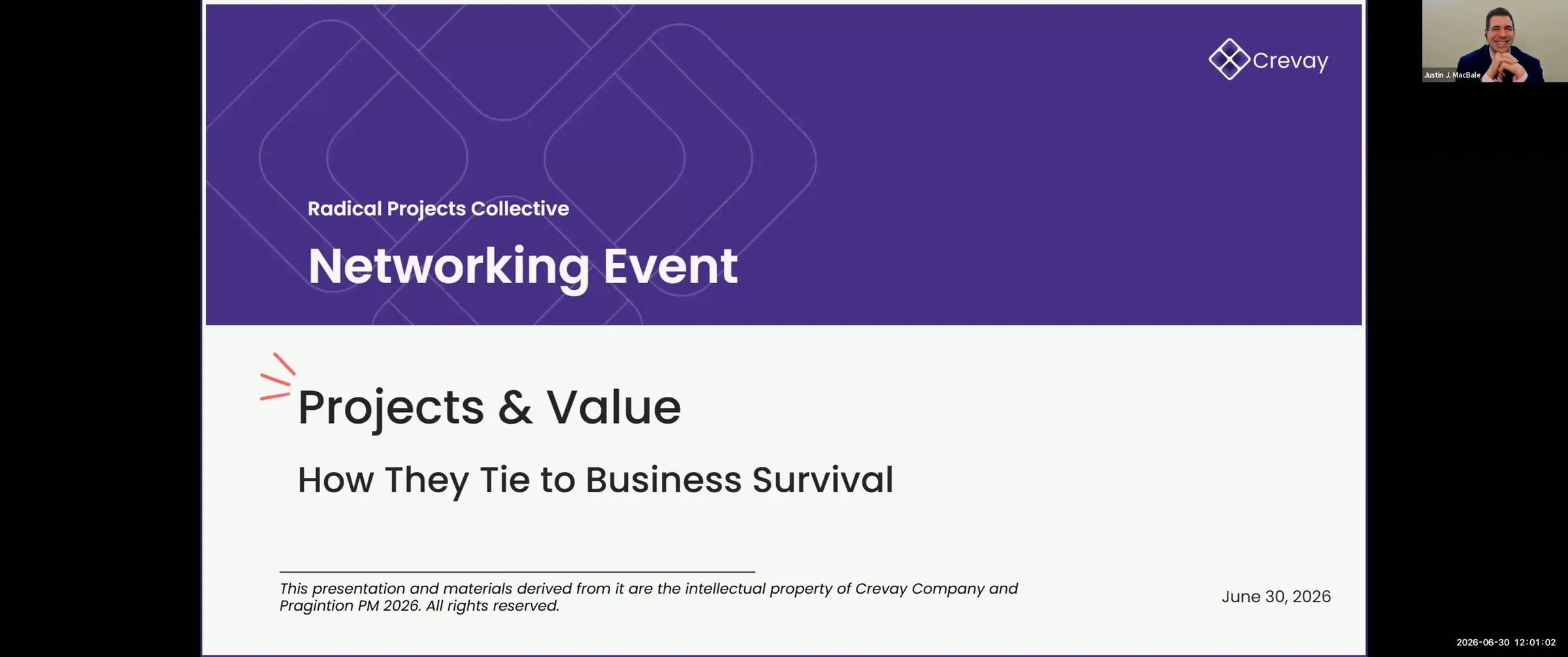
On 30 June 2026, a title slide went up on a video call hosted by Crevay Company for a group calling itself the Radical Projects Collective. It read: “Projects & Value: How They Tie to Business Survival.” In a small webcam tile in the top corner of the screen sat the speaker, Justin J. MacBale, a Texas-based programme manager with a dark suit, a wide smile and an argument he has been making, in essays and on podcasts, for more than a year.
The argument fits on the home page of his consultancy, Pragintion PM, in five words: “Projects are mechanisms for business survival.” What MacBale means by survival is specific. In his writing he lists four mechanisms: increasing or protecting revenue, controlling or reducing costs, limiting or mitigating liability or risk, and improving or changing market position. A project that touches none of them, in his account, is not a business project at all.
That definition has an edge, and in July 2026 he turned it on the people who sell entry into his profession. The essay, published on his firm’s site under the title “So You Think You Are A Real Project Manager?”, opens with a line familiar to anyone who has watched career-change content on social media: “If you planned a wedding or travel, you are a project manager.” MacBale did not soften his response. “To illustrate why I find the statement incredibly offensive and outlandish,” he wrote, “we have some buried assumptions we must unpack.”
The unpacking runs to several thousand words. Planning a wedding, he argues, involves plans, budgets and people, but the value it creates is personal; the person running it holds all the decision rights; its politics stay within one family; its consequences end soon after the party. A business project reverses each of those conditions. “Compare that to a business project,” he wrote, “a project manager has little to no authority to make decisions.” Decisions belong to sponsors and steering committees. The project manager’s work is to get those people the right information at the right time and persuade them to act on it.
His sharpest point is about what the wedding-planner pitch teaches. The skills career coaches list most often (being organised, taking notes, following up, generating reports) are, in his phrase, project “support” skills: the work of an administrator, analyst or coordinator. A candidate who leads with them, he warns, signals to hiring teams that they are a junior. He ends with a qualification and a verdict. The qualification: “This does not mean you cannot enter the field of project management (no gatekeeping)”. The verdict:
Not everything should be deemed a project, and not everyone has been or is a project manager.
The demand side explains why so many people are being told they already qualify. In 2021 the Project Management Institute, the field’s largest professional body, estimated that the global economy would need 25 million new project professionals by 2030, about 2.3 million a year. In the United States alone, the Bureau of Labor Statistics counts 1,094,300 project management specialists, with a median wage of $102,320 in May 2025 and roughly 76,500 openings projected each year over the following decade. A well-paid, unlicensed occupation with a forecast shortage is an obvious market for coaches.
There is a tension here that MacBale’s readers will notice, and it is fair to name it. He is himself a co-founder of a career-education business. PM Career Growth, which he runs with Elizabeth Dworkin, a career coach with Peak Transformation, sells memberships and on-demand lessons to project managers and describes itself as “a global education and career acceleration platform”. The difference he would draw is in the promise. His platform’s stated subjects are business acumen, executive presence, political sensitivity and systems thinking: the things, by his own argument, that a wedding does not teach. Whether a membership library can teach them either is a question his customers will answer.
This portrait draws on the public record: his essays, his guest appearances and the biographical details he has published. No employer or client has confirmed those details; where his accounts differ, we say so.
- New project professionals the world will need by 2030 (PMI, 2021)
- 25 million
- Project management specialists employed in the US, 2025 (BLS)
- 1.09 million
- Share of project professionals with high business acumen (PMI, 2025)
- 18%
- PMI’s global Net Project Success Score, measuring value, not just delivery (PMI, 2024)
- 36
Chapter two: From the Route to the War Room
MacBale’s account of his own career begins far from a steering committee. According to biographical details he has supplied for publication, he started in 2013 as a route sales representative for Frito-Lay North America, the snack maker, was named rookie of the year for its Portland zone that year, became a district sales manager in 2014 and spent 2015 to 2016 as an internal consultant. On his firm’s site he describes that period as “managing high-pressure operations in direct store delivery”, the part of the consumer-goods business where a salesperson stocks the shelves himself and a missed delivery is visible by morning.
The same details list a bachelor’s degree in general business and human resources from Portland State University and an MBA in business analytics and corporate strategy from Southern Methodist University’s Cox School of Business in Dallas, both with honours. From 2017 he worked for Hitachi Consulting, later Hitachi Vantara, rising from consultant to manager of advisory consulting by 2022. His site summarises the work as “custom software development, ERP transformations, business operating model design, and post-merger integrations.” In 2026, by his account, he became a senior manager at Hitachi Digital Services. He founded Pragintion PM in 2024 and co-founded PM Career Growth in 2025, so both ventures run alongside the day job.
Two things in that record need care. The first is arithmetic. His dated history begins in 2013, yet his site credits him with 17 years in business and technology, a training platform’s biography says “15+ years” and his July 2026 essays twice describe “nearly 20 years” of project-management experience. The second is scale. His site claims “$850M value realized”, “10 companies served” and “20 initiatives closed”; a release says he turned around a $600 million post-merger integration that was six months behind schedule. None of these can be checked from public sources, and readers should treat them as his figures. Two testimonials on his site, signed only with first names, describe a senior vice-president’s thanks and a 2.5-year SAP implementation in which, the product owner wrote, his team went “from behind schedule to finishing testing two weeks early, even with increasing scope.”
The reputation he trades on is a nickname. Clients and colleagues, he says, called him “The Closer”, the person brought in to stabilise a distressed project and see it through. The name now appears on his webinar billing (“Program Manager, The ‘Closer’”) and his LinkedIn headline. He has told the story of its origin on at least two podcasts, The Disgruntled PM in July 2026 and the Project Manager Connect Show that September; we have not heard those recordings and cannot repeat the details.
What he has published is the method. In a five-part series called “Turning the Tide”, posted in July 2025, he set out seven steps for a project already in trouble: define the scope, evaluate the current state, identify the gaps, address them, execute, monitor and report, and close. The advice is unglamorous on purpose. “Turning around a distressed project isn’t about heroics; it’s about discipline, judgment, and strategic focus,” he wrote. He tells the newcomer what not to do first: “Resist the urge to critique the previous project manager(s).” On the last step he is blunter still: “Closure isn’t a checkbox.” For MacBale a project is closed only when the business can run without the person who rescued it.
He is also candid about a credential he does not hold. He has no Project Management Professional certification, the PMI qualification that many job postings request. A June 2026 release built around a radio interview says he has replaced nine certified project managers on the strength of results alone; that is his claim and cannot be tested. The record is less tidy than a rejection of credentials, though. He lists a Professional Scrum Master I certificate from 2018 and an MIT Sloan design-thinking certificate from 2021. In November 2026, on International Project Management Day, he spoke on behalf of the graduating cohort of the PMO Business Practitioner programme run by TP Global Business Consulting. The case he makes is narrower than it first sounds: credentials are not proof of judgement, which is a different thing from saying they are worthless.
Career timeline (dates as published by MacBale)
- 2012
Graduates with honours from Portland State University (business and HR)
- 2013–2016
Frito-Lay North America: route sales representative, district sales manager, internal consultant
- 2017
MBA, SMU Cox School of Business; joins Hitachi Consulting
- 2021–2022
Senior consultant, then manager of advisory consulting, Hitachi Vantara
- 2024
Founds Pragintion PM
- 2025
Co-founds PM Career Growth with Elizabeth Dworkin
publishes the V5 model, the P8 lifecycle and “Turning the Tide”
- 2026
Senior manager, Hitachi Digital Services
essays on “real” project managers and on AI; speaks for the graduating PMO-BP cohort (November)
Chapter three: Beyond the Triangle
Every project-management student learns the triangle. Scope, time and cost are linked; move one and the others move with it; the traditional joke is that a client can pick any two. MacBale’s first major essay, published in July 2025, credits the model to Dr Martin Barnes in 1969 and then sets out to retire it.
His objection is not that the trade-offs are false. It is that they measure the wrong thing, and that they flatter the person being measured. “In reality, even when scope, time, and cost are well-controlled, initiatives can still fail,” he wrote. Worse, the constraints are rarely the project manager’s to control: “The truth is, PMs rarely have direct control over these core constraints.” Budgets and deadlines are fixed at portfolio approval, long before anyone is hired to deliver them. A framework that judges the project manager on variables set by others, he suggests, may be less a tool than an alibi.

In reality, even when scope, time, and cost are well-controlled, initiatives can still fail.
In its place he proposes what he calls the V5 model: five “value levers” a project manager must manage, namely people, resources, the solution, governance and cost. The list is less original than its emphasis. Adoption, culture and operational readiness sit under “people”; intellectual property sits under “resources”; safety and compliance sit under “solution”. The point is that a system can go live on schedule and still destroy value if nobody uses it, or if the business is not ready the day it switches over.
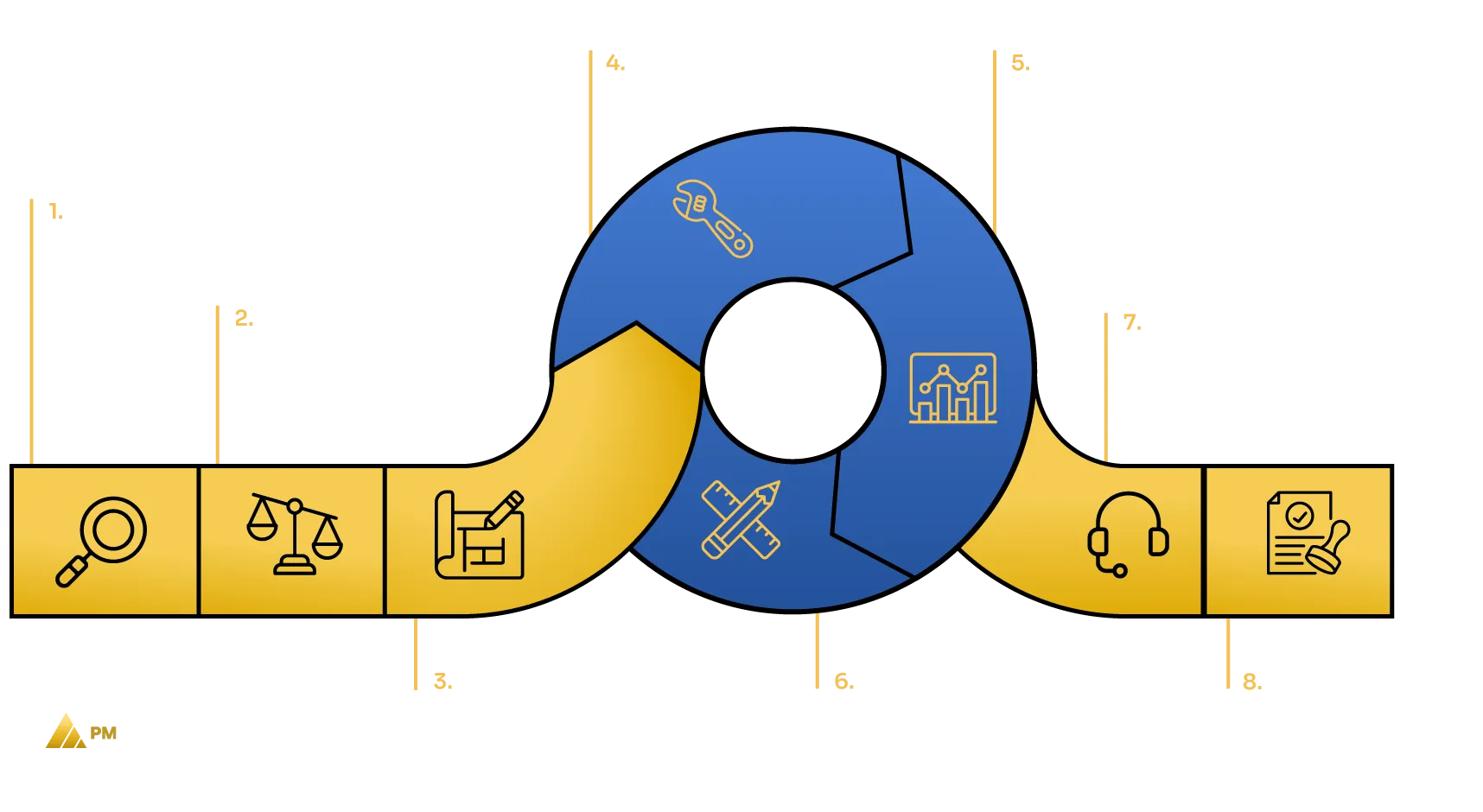
A companion essay replaces the standard five-phase project lifecycle with what he calls the P8: eight steps in which execution, monitoring and replanning run as a loop rather than a sequence, and a stage most textbooks skip, “Support & Business Stabilization”, comes before closure. His charge against the traditional sequence is partly about honesty. A plan that is assumed to stay fixed, he writes, “can pressure project managers to conceal delays or issues to maintain optics”.
Some of this he applies to mergers, where he says much of his consulting work has been. On the Master Your Merger podcast in July 2025 he walked the host, Dr Klint Kendrick, through eight stages of post-merger integration, from governance to cutover and stabilisation. In his writing on the subject he points to the transition services agreements that give an acquirer only a fixed period of access to the seller’s systems “before incurring punitive damages”. An integration, in other words, is a project with a contractual clock, and it is the setting in which time, cost and scope are most likely to be met while the deal’s value quietly leaks away.
The striking thing is how far the institutions have moved towards him. In 2024 the Project Management Institute published a study of nearly 10,000 practitioners that defined a successful project as one that “delivers value that is worth the effort and expense”. Measured that way, 48 per cent of projects were judged successful, 40 per cent produced mixed results and 12 per cent were failures, giving what PMI calls a Net Project Success Score of 36. The following year its Pulse of the Profession report concentrated on business acumen, finding that only 18 per cent of the 2,841 project professionals surveyed showed a high level of it. Those who did met their business objectives more often (83 per cent against 78) and saw fewer outright failures (8 per cent against 11).
Older evidence points the same way. A 2012 study of more than 5,400 large IT projects by McKinsey and the University of Oxford found that they ran, on average, 45 per cent over budget and delivered 56 per cent less value than predicted. The overrun is the figure people remember; the value shortfall is larger.
MacBale says that when he first argued along these lines he met resistance from practitioners, and that the ground shifted only when bodies such as PMI began publishing similar ideas. That is his account, and the convergence is real. It also leaves him with a problem every early advocate faces once the mainstream catches up: when the standards body is talking about value, what is distinctive about a consultant who talked about it first? His answer, so far, is specificity: named levers, named steps, and an insistence that the project manager be judged on the business outcome. He closed his triangle essay with a question for the profession: “Do these theories genuinely prevent failure, or do they merely offer a convenient narrative when projects go off course?”
Chapter four: The Machine in the Status Report
If the triangle essay is MacBale at his most constructive, the essay he published on 27 July 2026 is him at his most alarmed. Titled “Problems Artificial Intelligence Creates For High-Context Roles Like Project Management”, it begins by taking on a claim common in his industry: that AI can absorb the work of project administrators and coordinators and free project managers for strategy. He calls the idea “dangerous” and “objectively false (at least for now)”.
The forecasts he is arguing with are large. In 2019 the research firm Gartner predicted that by 2030 AI would eliminate around 80 per cent of the tasks of today’s project-management offices, including data collection, tracking and reporting. A 2026 survey of 1,651 project and portfolio professionals by the software company Smartsheet and Dimensional Research found that 97 per cent were experimenting with AI, but only 46 per cent trusted it to act without human supervision, and 74 per cent worried that their role could be replaced by AI within five years.
MacBale’s case against the forecasts is technical before it is philosophical. AI runs on data, and he lists the ways project data fails: it may belong to someone else, it arrives late, it sits in incompatible systems, and much of it is never written down at all. The politics of a steering committee, the history between two vendors, the reason a sponsor has gone quiet: these are the facts a project manager acts on, and they are, for obvious legal reasons, rarely recorded.
If your job requires you to act on information that is never published or tracked, then AI as a tool is not only limited but can be reckless to use.
The second half of the essay is about people. Using Bloom’s taxonomy, the educational model that ranks thinking from remembering up to evaluating and creating, he works through five prompts that PMI has recommended to project managers, among them drafting a weekly status update and turning meeting notes into action items. Each, he argues, hands a machine the higher-order work of analysing, judging and tailoring a message to its audience, and each repetition leaves the human slightly less practised. His deepest worry concerns the people at the bottom of the ladder. Entry-level jobs, he writes, are where people learn by making mistakes; automate the mistakes away and the apprenticeship goes with them. “So where does someone get entry level experience or how does someone enter a professional career with little to no experience?”
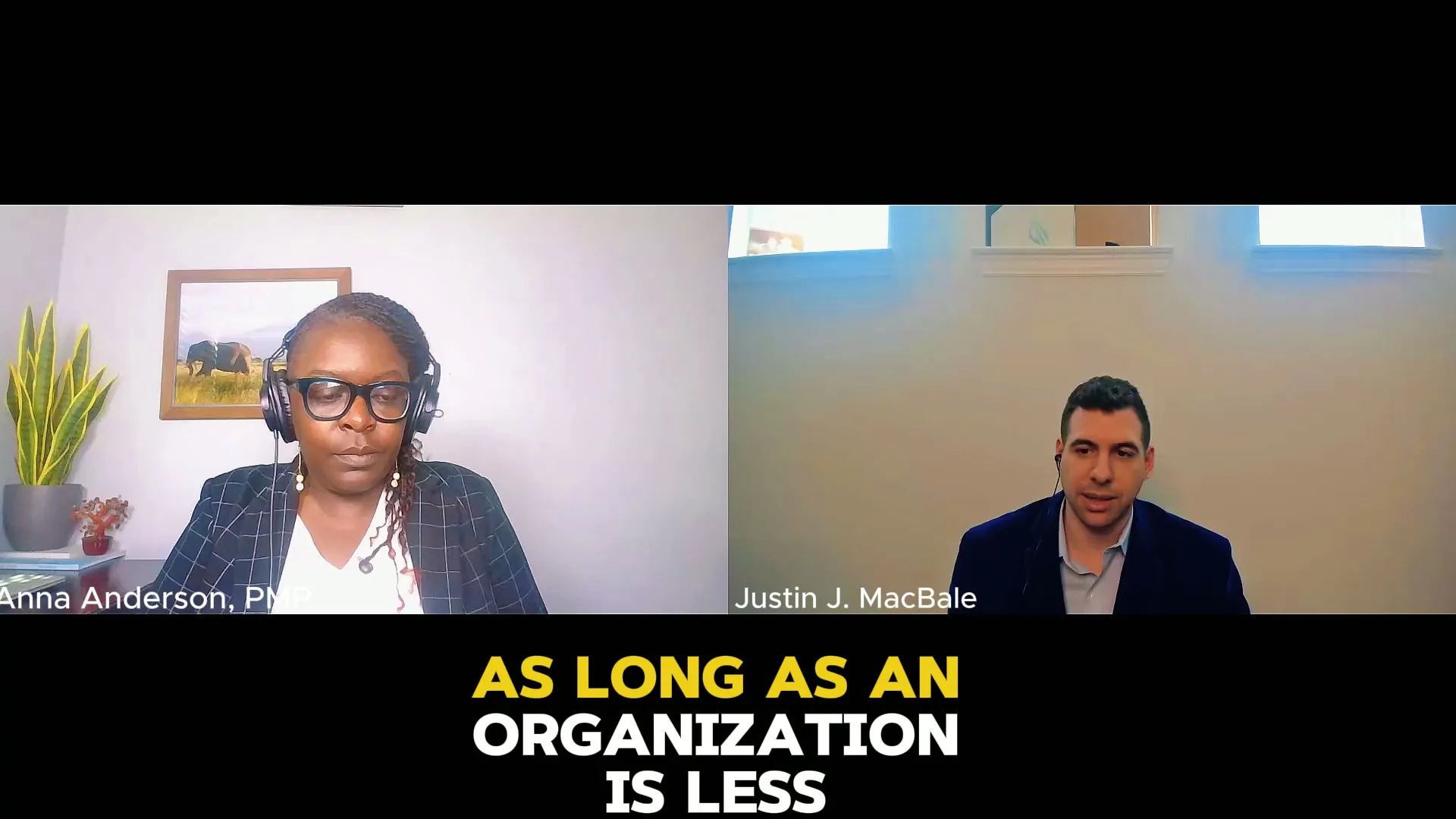
He is not, by his own description, against the technology. “Ironically I am anti-AI or leery of AI within project management but I am also a strong advocate for AI usage in low-context roles or situations,” he wrote, citing repetitive, standardised transactional work of the kind once handed to robotic process automation. In a release accompanying a June 2026 radio interview, he put it more briefly: “AI can spit out a project plan, but it can’t understand office politics or historical context. Junk in, junk out. Project management is a people business.” The same release said AI could support project-support roles given timely data, a softer position than the July essay takes. His view appears to have hardened in the space of a month, and it would be worth hearing why.
There are fair objections to his case. Some of what he describes as uncodified is being codified fast: meeting transcripts, chat logs and ticket histories now capture much of what once lived only in a project manager’s head. His argument about skills decay is a prediction, not yet a measurement. And the survey that finds three-quarters of practitioners fearing for their jobs also finds 87 per cent saying AI still needs human input at least some of the time, which is closer to his position than to Gartner’s. On the central point, though, the evidence leans his way. PMI’s own research says the scarce quality in the profession is business judgement, not reporting, and judgement is the thing he says AI cannot supply.
His remaining questions are commercial. Pragintion PM’s public record is a methodology page, two testimonials signed with first names, and a run of essays. PM Career Growth’s podcast published six episodes between November 2025 and January 2026 and none in the feed since, though live sessions continued on YouTube into March. A profession of more than a million people in the United States alone will not be changed by a blog. Whether these ventures grow, and whether he keeps them alongside a senior consulting role, are things only he can say.
The test he sets for others is the one he will face. He has argued for a year that delivering the plan is not the same as delivering the value, and that the people who claim the title should be able to show the difference. In his July essay on who deserves the title, he left the instruction plain: “first get clear on your goals, determine the requirements needed and identify the gaps.”