Can You Build Innovation Where the Map Says It Isn’t?
Europe’s innovation is concentrated in its capitals and its north. Greece is trying to spread it to farming regions with parks, hubs and competence centres. The evidence on what works is thinner than the brochures suggest.
JOIST (via joistpark.eu)
Each year the European Commission publishes a map. It colours Europe’s regions by how well they innovate, measured across indicators from patent applications to adult learning, and the pattern changes slowly: strongest in the north and west, palest along much of the southern and eastern edge. In the 2025 edition, Greece’s thirteen regions run from Crete, at 87.6 per cent of the EU average, to the South Aegean, at 50.2. Thessaly, the agricultural plain around Larissa, sits at 68.1 per cent, classed as an “Emerging Innovator+” and ranked 189th (RIS, 2025).
The question this map poses to governments, and increasingly to private operators, is whether innovation can be built in a pale region, or whether it only grows where universities, capital and skilled people already cluster.
What a park is for
For decades the standard answer has been the science park: a managed site, usually near a university, where young companies rent space and buy services. The model is now global. The International Association of Science Parks and Areas of Innovation, whose members span dozens of countries, reported in its 2024 survey that 93.7 per cent of its members run business incubators and 81.7 per cent accelerators. Asked what matters most for success, members put links to universities first (61.1 per cent), then talent (58.7 per cent). Most of their tenants are small: 46.2 per cent have fewer than ten employees (IASP, 2024).
Those success factors are exactly what a region like Thessaly lacks in quantity. Its share of the workforce employed as ICT specialists is 4.9 per cent of the EU level, among the lowest of any region measured; adult participation in lifelong learning is about a fifth of the European rate (RIS, 2025). Nearly one job in five is in agriculture or mining. Its firms employ 2.82 people on average.
Yet the same data contain a surprise. On innovation spending other than R&D, which covers things like new machinery, software and design, Thessaly ranks fourth of all regions in the Scoreboard, and its small firms introduce new products at 176 per cent of the EU rate. What has collapsed since 2018 is collaboration: the share of innovative small companies working with others (RIS, 2025). The region’s firms are not idle. They are alone.
Greece’s public answer
Greece’s government has built several layers of support aimed at that isolation. There are European Digital Innovation Hubs, co-funded by the EU, which help small companies and public bodies adopt digital tools; Thessaly’s is Health Hub, focused on health and pharmaceuticals. There are ten competence centres, sector-specific bridges between research and industry, on which public spending has passed €8.3 million, according to the General Secretariat for Research and Innovation. Visiting Larissa in July 2025, the Secretary-General, Tasos Gaitanis, called the centres “a critical link between research and the market” (GSRI, 2025; our translation).
The national figures have improved. Greece’s R&D intensity rose by 0.7 percentage points between 2014 and 2024, one of the largest gains in the Union, to 1.53 per cent of GDP, against an EU average of 2.2 per cent (Eurostat, 2025; EKT via To Vima, 2026). In the European Innovation Scoreboard the country scores 75.8 per cent of the EU average, 15.3 points higher than in 2018 (EIS, 2025). Startup funding exceeded €732 million in 2025 across 95 rounds, with a record 18 active venture funds (Found.ation via The Recursive, 2026).
But the same statistics carry two warnings. The number of researchers in Greece fell 6.9 per cent in 2024 even as spending rose (EKT via To Vima, 2026). And the country is still recovering from an emigration wave in which, by one estimate, 1,079,992 people of working age left between 2010 and 2022, most of them aged 25 to 44 (ENA via To Vima, 2024).
The private experiment
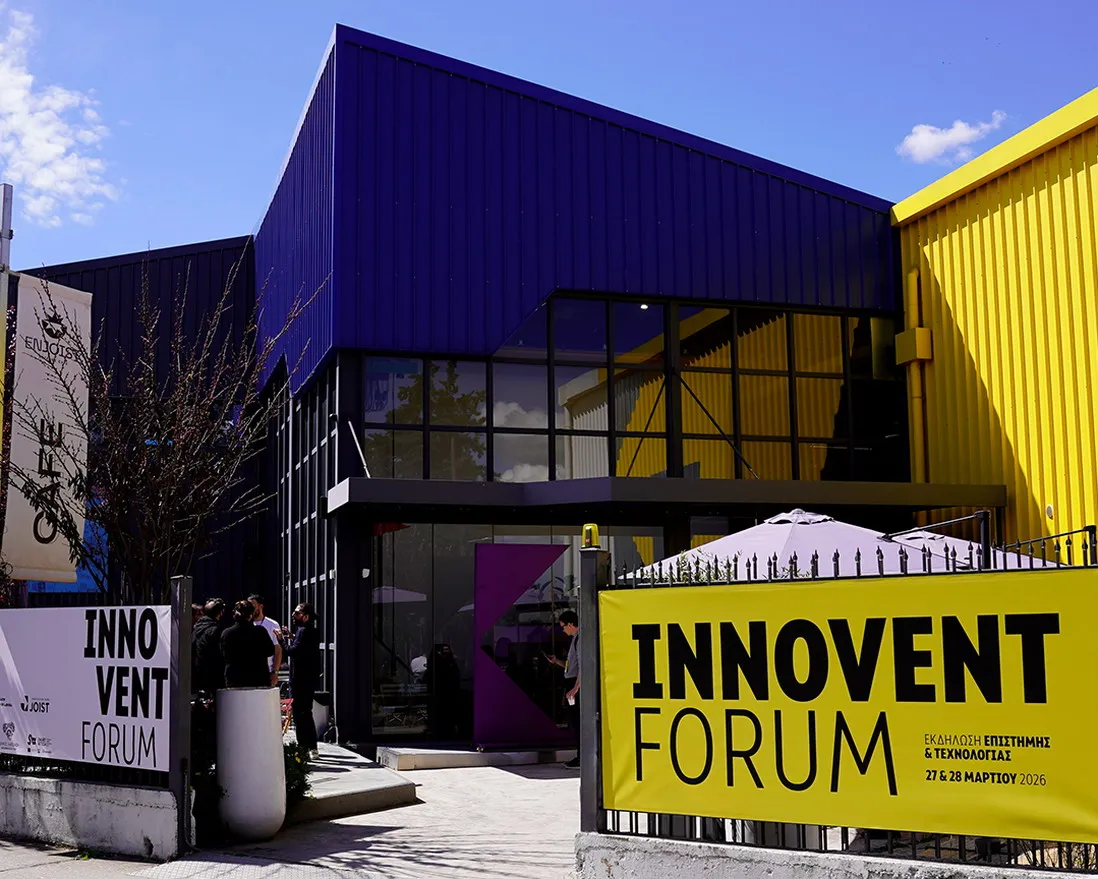
Into this mix has come a less common model: the privately financed park outside the capital. The most visible example is JOIST Innovation Park in Larissa, opened in 2022 in a converted metalworkers’ building by Tasos Vasiliadis, whose Institute of Entrepreneurship Development had spent seventeen years running EU-funded projects from the city. Greece’s research secretariat describes JOIST as the country’s first private innovation-transfer park (GSRI, 2025). It houses Thessaly’s Health Hub and the PYTHEIA competence centre alongside startups and training rooms.
Vasiliadis has argued that the location is the point. Speaking to HuffPost Greece in 2025, he said:
The decision was bold, because innovation ventures usually concentrate in the big urban centres, but we believe that the future of innovation depends not on geography but on opportunities and the right infrastructure.
The economic logic of a private park differs from that of a public one. A government-funded centre is judged on whether it spends its budget well; a private one has to earn its keep from rents, services, events and memberships. In 2023 the business site Powergame reported that JOIST had seven revenue streams and expected fourteen at full operation, with profitability the first goal and export of the model the second (Powergame, 2023). Since then the company has opened a smaller space in Ioannina, launched a franchise, and announced a building in Brussels.
Private operators still want the state as a partner. Vasiliadis put it plainly in the same interview:
Innovation and entrepreneurship must have the support of the state. So far JOIST has had a positive response, but there is still some way to go before initiatives like this are properly built into national development strategies.
What we do not know
The difficulty for anyone assessing parks, public or private, is evidence. Occupancy rates, survival rates of tenant companies, jobs created and the number of graduates who stayed or returned are the measures that matter, and few Greek parks or hubs publish them in a form that can be compared. The European indices move slowly and cannot attribute change to a single site. A region’s score can rise because of one large investment, or fall because a survey sample shifted.
There are also structural limits that no building can fix alone. Filippos Zakopoulos of Found.ation, which tracks Greek startup funding, argues that the country’s next problem is focus rather than money: “What we haven’t really developed yet is deep specialization in a few areas where we can become globally known.” He also sees early signs of returning talent: “I do believe there is a small trend toward brain gain” (The Recursive, 2026).
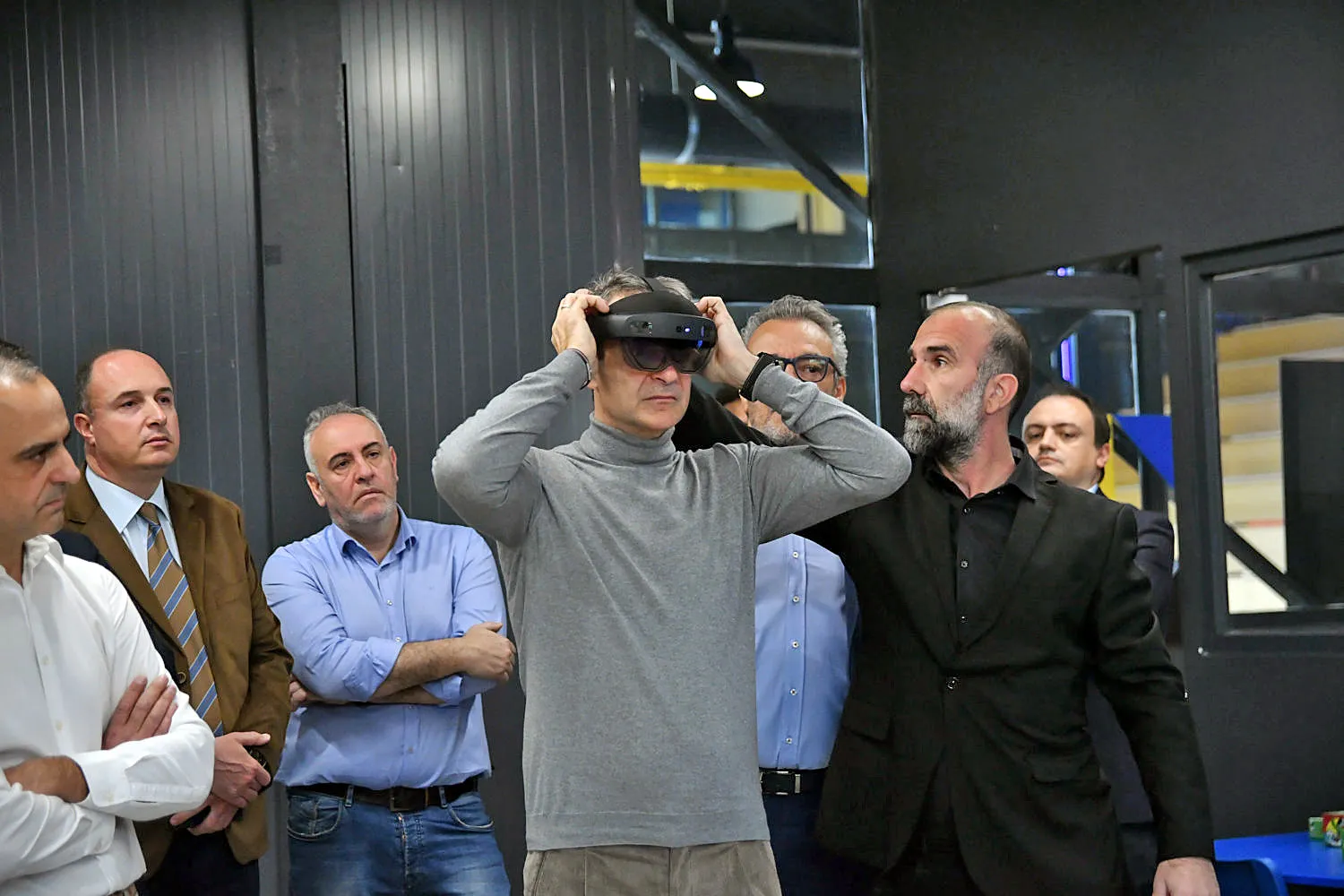
Parks argue that they are where such specialisation and return could start: a place where a returning engineer finds a desk, a farm-equipment company meets a university lab, and a schoolchild sees a 3D printer for the first time. Vasiliadis has framed the ambition as replication. “Our aim is for JOIST to become a model of innovation park that expands, is reproduced and strengthens the local and international ecosystem,” he told HuffPost Greece (our translation).
That is the test the Commission’s map will eventually apply, slowly and without attribution. Whether pale regions darken will depend less on how many parks open than on whether the firms inside them grow, hire and keep their people, and on whether anyone publishes the numbers that would show it.
Sources
- RIS, 2025 (opens in a new tab)
- EIS, 2025 (opens in a new tab)
- IASP, 2024 (opens in a new tab)
- GSRI, 2025 — press release on the Secretary-General’s visit to Larissa (9 Jul 2025) (opens in a new tab)
- Eurostat, 2025 (opens in a new tab)
- EKT via To Vima, 2026 (opens in a new tab)
- ENA via To Vima, 2024 (opens in a new tab)
- Found.ation via The Recursive, 2026 (opens in a new tab)
- Powergame, 2023 (opens in a new tab)
- HuffPost Greece, 10 Mar 2025 (opens in a new tab)
- iED / Health Hub (opens in a new tab)