From the Shelf to the Phone Line
Organised retail crime pushed stores to tag, film and track more of what they sell. As shelf theft eases, losses are moving into gift cards, loyalty accounts and phone scams, and the tools are being rebuilt to follow.
Retail Clinic (via YouTube)
Between February and April 2026, 66 retail companies, operating 143 brands and accounting for about 31.6 per cent of US retail sales, answered the National Retail Federation’s questions about theft. Their answers, published on 30 July as The Impact of Theft & Violence 2026 with the Loss Prevention Research Council, marked the first clear reversal in years. Shoplifting incidents fell 12.4 per cent in 2025 compared with 2024. Merchandise theft fell 8.1 per cent. Retailers put the improvement down to what they had spent on security (NRF/LPRC, 2026).
The same respondents described a crime that was changing shape rather than going away. Sixty-nine per cent reported more phone scams. Fifty-one per cent reported more loyalty-programme fraud, 42 per cent more gift-card theft or fraud. Half saw more repeat offenders; 40 per cent reported more incidents tied to organised retail crime; 37 per cent more “walkout” or “pushout” thefts, in which goods are simply carried or wheeled out without payment (NRF/LPRC, 2026).
To understand how the store got here, and what it now uses to defend itself, it helps to go back three years.
The surge
In the industry’s usage, organised retail crime (ORC) is theft carried out by groups, often to resell the goods, as distinct from opportunistic shoplifting. Its rise after the pandemic is visible in every series the industry keeps. Comparing 2023 with 2019, retailers reported a 93 per cent increase in the average number of shoplifting incidents a year and a 90 per cent increase in the money lost to them; 76 per cent said ORC-linked shoplifting worried them more than it had a year before (NRF/LPRC, 2024). Incidents rose another 18 per cent in 2024, and 67 per cent of retailers said they had seen transnational ORC groups involved (NRF/LPRC, 2025).
One figure in particular bears on how stores are run, and it is not a dollar amount. In the 2023 National Retail Security Survey, 67 per cent of retailers said ORC offenders had become more violent and aggressive over the previous year (NRF, 2023). Once confronting a thief carries a real risk of injury, the job of store security shifts. The aim becomes to deter, record and build a case later, with staff kept out of the way.
That same survey found 53 per cent of retailers had raised their technology and software budgets (NRF, 2023). By 2026 the list of responses to violence included management training (72 per cent), employee training (65 per cent) and “risk-intelligence technologies” (61 per cent) (NRF/LPRC, 2026).
The exit, rebuilt
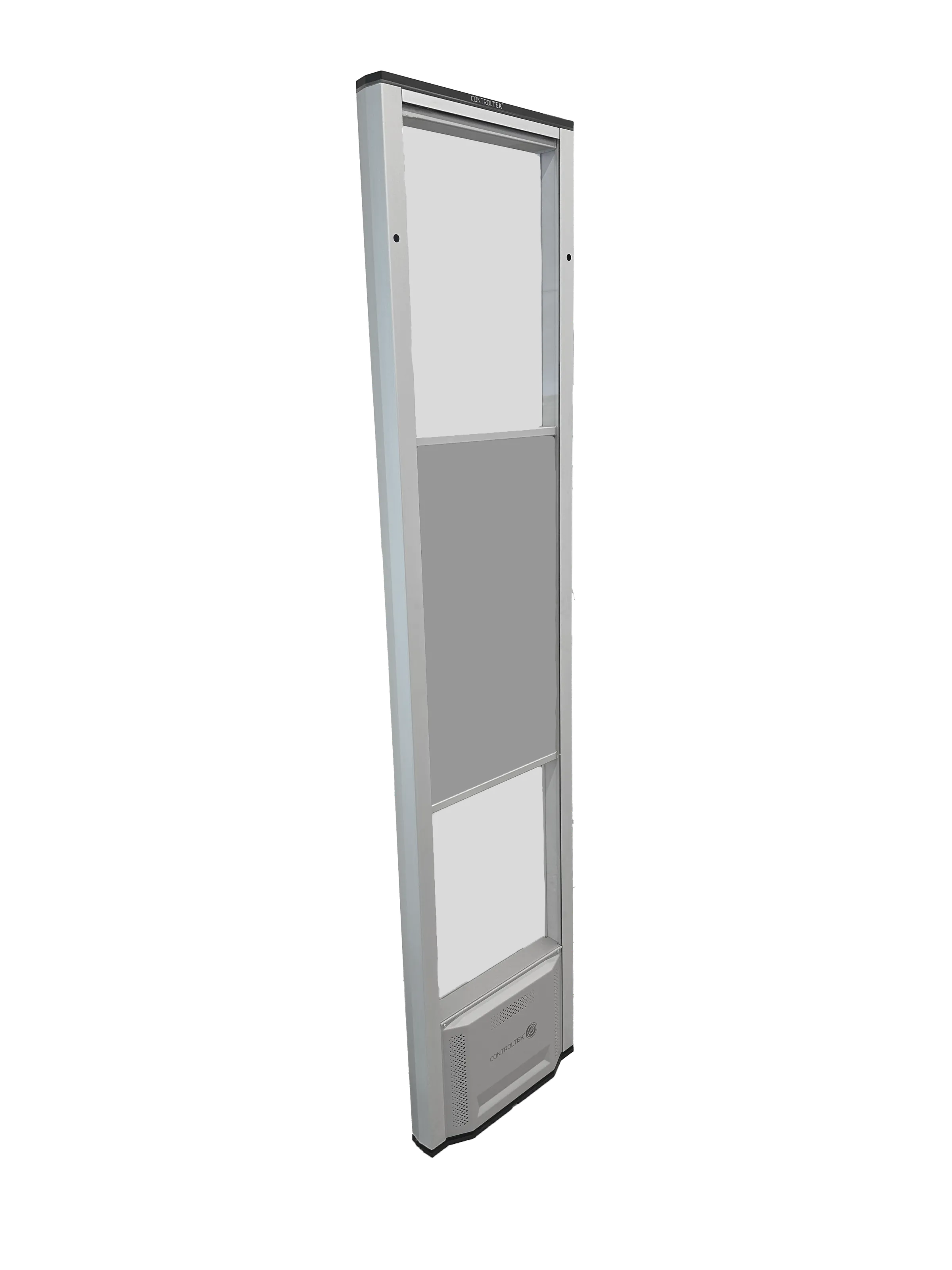
The oldest tool in the store is electronic article surveillance: a tag on the product and a pair of pedestals at the door that alarm if the tag leaves unpaid. Its weakness has always been the moment after the alarm. The system knows that something left; it does not know who took it, and a busy associate may not look up in time.
Suppliers have spent the past few years attaching information to that moment. CONTROLTEK, the New Jersey company run by Tom Meehan, showed an exit system with real-time SMS alerting at NRF PROTECT in 2024, according to a company announcement (CONTROLTEK, 2024). Its SAM2CAM pedestal, which won the Loss Prevention Research Council’s Product Protection Summit award for “Advancements in EAS” at NRF PROTECT 2026, hides a camera inside the pedestal and links each alarm to eye-level facial imagery (EIN Presswire, 2026). The company says the idea came from a question its customers kept asking: “How do we get a better face shot?” Meehan summarised the brief this way:
Retailers told us they didn’t need more cameras. They needed better evidence.
The ambition now is to make the exit a sensor hub. CONTROLTEK describes its SmartPost Z as combining EAS, RFID, AI-powered video analytics, people counting and item-level intelligence in one platform (EIN Presswire, 2026). The shift carries obvious questions about privacy (who sees face-level images of every customer who triggers an alarm, including customers whose tags were simply left on at the till, and how long those images are kept), and retailers adopting such systems will have to answer them for their customers and, in some places, their regulators.
Knowing what you have
The quieter change is upstream of the door. Radio-frequency identification lets a retailer count stock by radio rather than by hand. Studies by Auburn University’s RFID Lab found store inventory accuracy of about 63 per cent without item-level RFID and about 95 per cent with it, and out-of-stocks falling by up to half (Auburn RFID Lab via Just Style, 2014–16). Those findings are a decade old, but adopters are spending on them: ABI Research forecasts that spending on UHF RFID will exceed US$10 billion in 2030, with about 118 billion inlays shipped that year, and estimates that clothing and footwear account for 74 per cent of retail RFID software spending in 2025 (ABI Research).
RFID was sold first as an inventory tool. Its value against theft is indirect: a retailer that knows exactly what should be on a shelf discovers sooner, and more precisely, what is not. Meehan frames it in operational terms:
RFID is creating new opportunities for organizations to understand what they have, where it is and how it’s moving.
The reporting gap
Better evidence matters because so little store theft reaches the justice system. In the 2026 study, 63 per cent of retailers said they report fewer than half of store theft incidents to police. The reasons they gave were that losses were small or fell below felony thresholds (60 per cent) and concerns about the law-enforcement response (54 per cent) (NRF/LPRC, 2026).
That gap is one reason police statistics and retailer surveys diverge. The Council on Criminal Justice, using police-reported data from large US cities, found shoplifting in the first half of 2026 still 5 per cent above the same period of 2019, the only one of 13 offences it tracks that remained above pre-pandemic levels (CCJ, 2026). Retailers report falling incidents; police data show shoplifting still above 2019. Both can be true, because they count different things.
The surveys deserve their own caution. NRF’s figures come from large retailers who choose to respond, from 66 companies this year to 177 in some earlier rounds, not from a national sample, and the trade publication Retail Dive has questioned how representative they are (Retail Dive). NRF stopped publishing a national dollar estimate for shrink after its 2023 survey, which put 2022 losses at US$112.1 billion (NRF, 2023).
Where the crime went
If shelf theft is falling and fraud rising, the store’s defences are pointed partly at yesterday’s problem. A pedestal camera does not see a gift card drained over the phone, or a loyalty account taken over with a stolen password. Those losses are investigated in transaction logs, call recordings and online marketplaces. Meehan has spent years on that territory: he has spoken on dark-web investigations at the Retail Industry Leaders Association’s Retail Law Conference (2019), and on cybercrime, organised retail crime and human trafficking at the New England Crime Analysis and Intelligence Conference (2022) (Thinkers360).
The digital turn brings a problem of its own. Retail investigations rest on recordings: exit images, CCTV, recorded interviews. Generative AI weakens all of them, because once convincing fakes are possible, genuine evidence can be dismissed as fake too. Meehan took this up in a December 2025 column on the “liar’s dividend” for Loss Prevention Magazine, where he is retail technology editor, arguing for attention to chain of custody, the documented trail of who handled evidence and when:
At the end of the day, the liar’s dividend isn’t just about how reality could be faked. It’s about making everyone doubt the truth altogether.
What the store looks like now
The result is a store that collects more information than ever. Tags carry radio chips; pedestals carry cameras; staff receive more training. In EssilorLuxottica’s case, asset-protection staff covering about 300 stores each now have an AI assistant, B.E.C.K.I., that answers routine questions such as how to export video and when to call the police, built after a design-thinking workshop CONTROLTEK facilitated in November 2024 (NRF, 2026).
The data so far suggest that investment has helped at the shelf. They also suggest that the most determined offenders have moved to channels where cameras matter less. For the next round, the important tools may be less the ones at the exit than the ones that can show, in a form a court or a sceptical public will accept, what really happened.
Sources
- NRF/LPRC, 2026 (opens in a new tab)
- NRF/LPRC, 2025 (opens in a new tab)
- NRF/LPRC, 2024 (opens in a new tab)
- NRF, 2023 (opens in a new tab)
- CCJ, 2026 (opens in a new tab)
- Retail Dive (opens in a new tab)
- Auburn RFID Lab via Just Style (opens in a new tab)
- ABI Research — abiresearch.com/press/adopter-spending-on-uhf-rfid-mark… (opens in a new tab) ; abiresearch.com/blog/rfid-in-retail (opens in a new tab)
- EIN Presswire (CONTROLTEK, SAM2CAM award), 16 Jun 2026 (opens in a new tab)
- CONTROLTEK, 2024 (exit solution with SMS alerting) (opens in a new tab)
- CONTROLTEK, Auburn RFID Lab advisory board, Sept 2026 (opens in a new tab)
- NRF, 2026 (EssilorLuxottica / B.E.C.K.I.) (opens in a new tab)
- Loss Prevention Magazine, Dec 2025 (opens in a new tab)
- Thinkers360 (speaking record) (opens in a new tab)