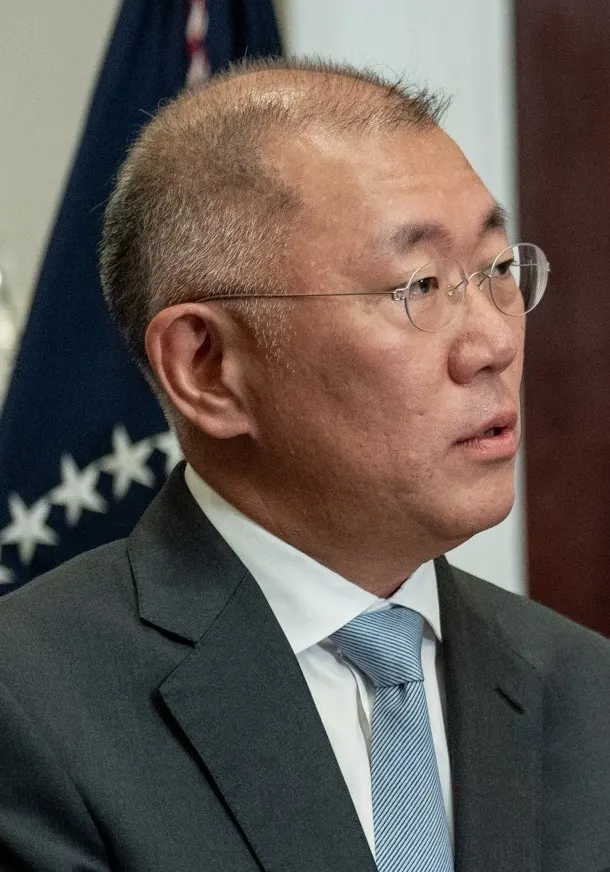
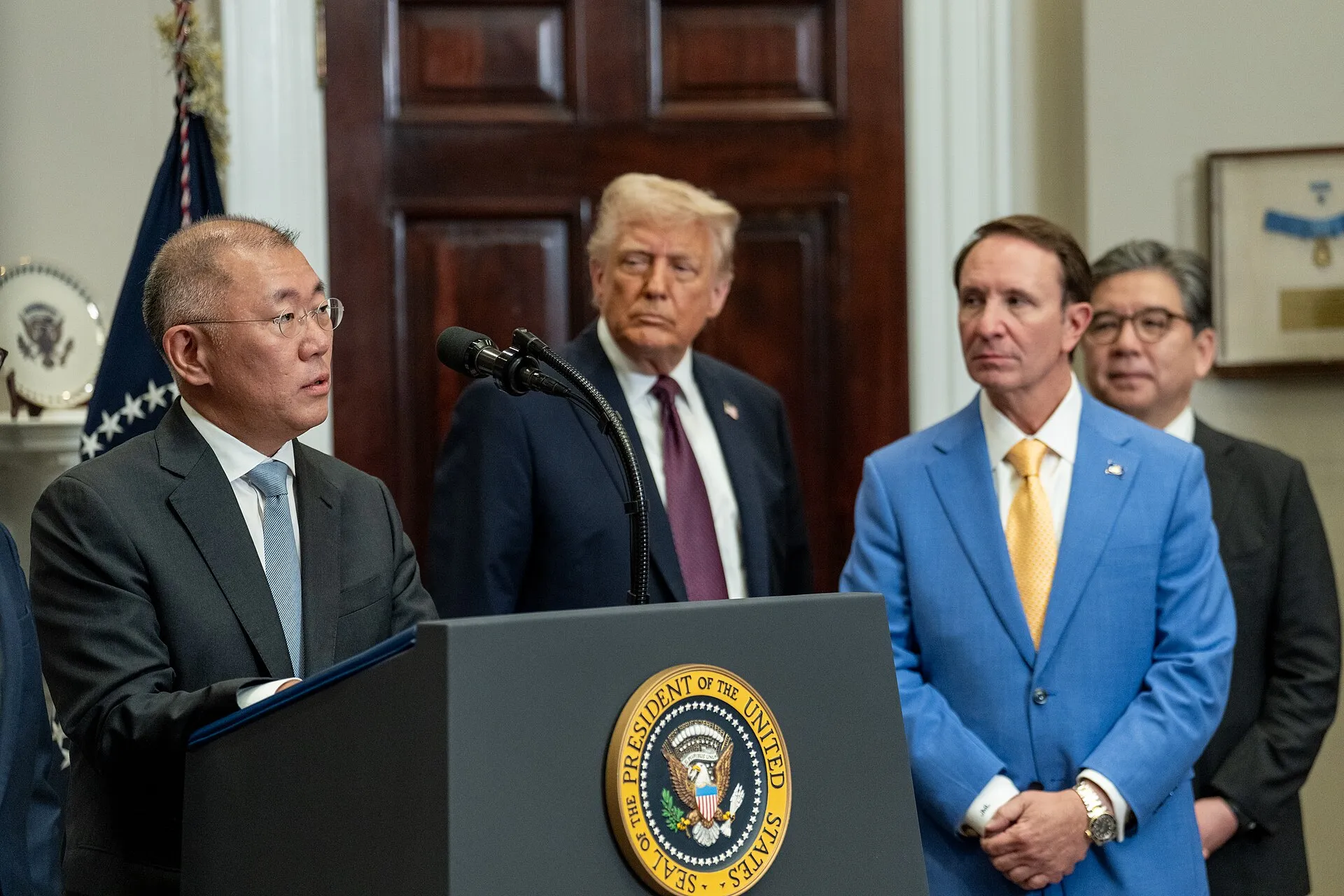
Photo: The White House / Wikimedia Commons, public domain
How Chung Eui-sun rose through Hyundai Motor to chair its group
From a deputy manager's post in San Francisco to chair of Hyundai Motor Group, here is how his career ran alongside the carmaker's expansion.
Hyundai Motor Company sold about 4.14 million vehicles worldwide in 2025. Chung Eui-sun has chaired Hyundai Motor Group, the group that includes it, since October 2020. Before that he held posts at Hyundai and Kia in procurement, IT, sales, after-sales and corporate planning, starting in 1999.
The scale of that business is easier to see from its history. The company was established in 1967, and its first model, the Cortina, was released in 1968 with Ford Motor Company. Its worldwide sales were 2,533,695 units in 2005 and about 4.14 million in 2025. Chung's own rise ran alongside that growth, from a deputy manager's post in San Francisco to the chair of a group that now includes Hyundai, Kia and Genesis.
Education and early career
Chung attended Whimoon High School and then Korea University, where he took a bachelor's degree in business administration in 1993. He also earned an MBA in 1997 from the University of San Francisco. From 1994 to 1999 he was a deputy manager in San Francisco, with Hyundai Precision and Industries.
From 1994 to 1999 he was a deputy manager at Hyundai Precision and Industries in San Francisco. Between 1997 and 1999 he worked for Itochu Corporation in New York. From 1999 to 2001 he was a director in Hyundai's procurement planning and coordination group.
Back in Korea, he moved across functions. From 2000 to 2002 he was deputy operating officer at the Hyundai Information Technology Center. In 2001 and 2002 he held the same title in two further units: the domestic sales and marketing division of Hyundai Motor, and the Hyundai-Kia after-sales service division. From 2003 to 2005 he was chief operating officer of the Hyundai-Kia corporate planning division.
Kia and the road to the group chair
In 2005 he became president of Kia Motors Corporation, and he held the post until 2009. Forbes credits him for the Kia Cee'd's performance in Europe, along with the Soul and Forte.
He was vice chairman of Hyundai Motor Company from 2009 to 2018, then executive vice chairman of Hyundai Motor Group from 2018 to 2020. He became chairman of the group in October 2020. His current title is executive chairman and one of three CEOs of Hyundai Motor Company.
Outside the company, he was named a Young Global Leader by the World Economic Forum in 2006. In 2003 the President of the Republic of Korea commended him. In 2023 he received a British honour, an honorary commander's rank in the Order of the British Empire. He has also served as president of the Asian Archery Federation since 2005.
What the group has built
The group's roots go back to 1947, when Hyundai Engineering and Construction was founded. Hyundai Motor Company followed in 1967 as a South Korean multinational automaker, with its headquarters in the Hyundai Motor Group complex in Seoul.
The Pony, released in 1975, was the first South Korean car. Exports began in Ecuador in 1976, and the company entered the British market in 1982. In 1986 it began selling cars in the United States.
The company then built its own engineering base. The midsize Sonata in 1988 was its first model with its own technology, and in 1991 it introduced the Alpha, its first proprietary gasoline engine. In 1996 it established Hyundai Motor India Limited, with a plant near Chennai. In 1998 it acquired a majority of Kia Motors.
Quality and volume followed. In 2004 the company ranked second in initial quality in North America, according to J.D. Power and Associates. In 2011 it sold 4.05 million cars worldwide, a total that made it the fourth-largest automaker group. As of November 2024 it was the third-largest carmaker by production, behind Toyota and Volkswagen.
The range now covers passenger cars, sport utility vehicles, commercial vehicles and hydrogen fuel-cell models. Its battery-electric vehicles run on the E-GMP platform, and its sub-brands are Ioniq and N. Genesis, its luxury subsidiary, sits alongside Hyundai and Kia in the group.
Published profiles describe the Ulsan plant as the largest single integrated car factory in the world. They give the site as about 5,000,000 square metres, with around 31,000 workers and an annual completed-vehicle capacity of 1.52 million units.
In 2025 the company recorded record annual revenue of ₩186.3 trillion. Operating profit fell to ₩11.47 trillion in the same year, a period marked by tariff and competitive pressures. The company sold its vehicles in 193 countries through about 5,000 dealerships and showrooms.
- 1993
Bachelor's in business administration, Korea University
He took the degree at Korea University in 1993.
- 1994
Deputy manager in San Francisco, Hyundai Precision and Industries
He held the post there from 1994 to 1999.
- 1997
MBA, University of San Francisco
The degree was awarded in 1997, the year his Itochu Corporation posting in New York began.
- 1999
Director, Hyundai Procurement Planning & Coordination Group
He held the post from 1999 to 2001.
- 2003
Chief operating officer, Hyundai-Kia corporate planning division
He held the post from 2003 to 2005.
- 2005
President, Kia Motors Corporation
He held the post until 2009, and Forbes credits him with the Kia Cee'd's success in Europe, along with the Soul and Forte.
- 2009
Vice chairman, Hyundai Motor Company
He held the post until 2018.
- 2020
Chairman, Hyundai Motor Group
He was appointed in October 2020 and is executive chairman and chief executive of the group.
- Vehicles sold worldwide by Hyundai Motor Company in 2025
- 4.14 million
- Employees worldwide at Hyundai Motor Company
- 75,000
- Countries in which Hyundai Motor Company vehicles are sold
- 193
- Annual completed-vehicle capacity of the Ulsan plant
- 1.52 million
How the group is organised
The group is built around three brands: Hyundai, Kia and Genesis. Hyundai Motor Company holds a stake in Kia, and it is led by three chief executives, of whom Chung is one. In our reading, keeping three brands under one holding structure lets each brand keep its own range while the group shares scale.
For other chief executives, the clearest lesson is the order of his career. He held posts in procurement planning, IT, domestic sales and marketing, after-sales service and corporate planning before running Kia in 2005. In our judgement, that sequence gave him a view of the chain from supplier to customer. A sensible test for any leader is whether each function can explain its own results to the others.
Lessons for leaders
- Work across functions before taking the top job. Chung's posts, as recorded in his career history, span procurement planning, IT, domestic sales, after-sales and corporate planning before he became president of Kia Motor
- A sensible test is to judge a model by its results in one region first. Forbes credits Chung with the Kia Cee'd's success in Europe, along with the Soul and Forte.
- Keep entering new markets over long periods. Exports began in Ecuador in 1976, the company entered the British market in 1982 and began selling cars in the United States in 1986. In 1996 Hyundai Motor India Limited was e
- Build your own core technology. The midsize Sonata, launched in 1988, was the first model with the company's own technology, and the Alpha engine of 1991 was its first proprietary gasoline engine.
- Track quality against outside benchmarks. In 2004 the company ranked second for initial quality in North America, according to J.D. Power and Associates, which gave it an external measure to aim at.