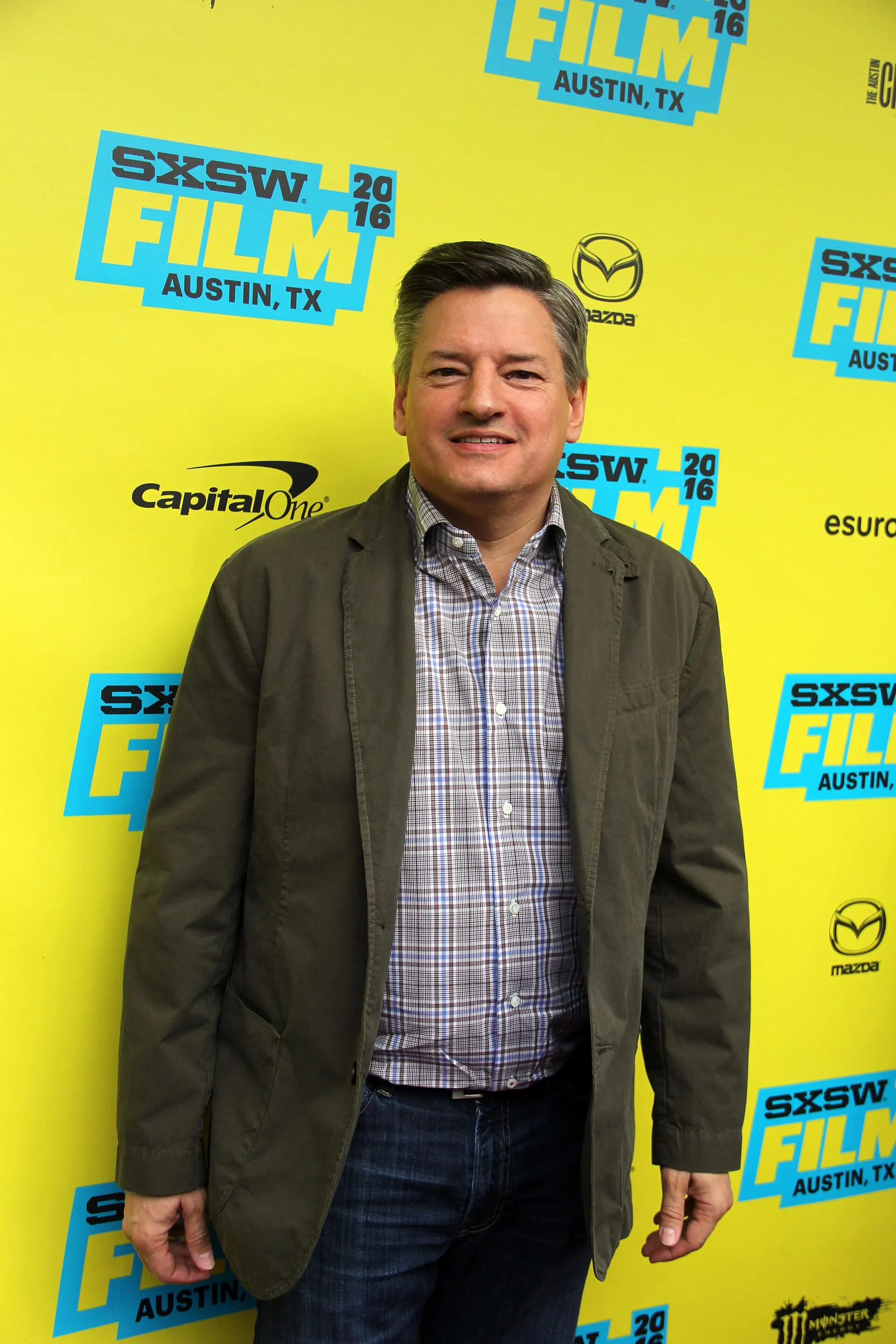
Photo: Kevin Paul / Wikimedia Commons, CC BY 4.0
How Ted Sarandos shaped the original programme at Netflix
From a job at a video store to co-chief executive of Netflix, which counted 325 million paid memberships as of 2026.
Ted Sarandos helped build the part of Netflix that makes its own shows. Netflix is a subscription streaming service that offers original and acquired films and TV. As of 2026 the company counted 325 million paid memberships across more than 190 countries.
His breakout early original series was House of Cards, a David Fincher series starring Kevin Spacey. Netflix bought it in a March 2011 deal worth $100 million. It came after Lilyhammer, the title with which he led the first wave of Netflix original programming. The purchase set a pattern of buying several seasons up front, with no pilot order.
From a video store to Netflix's content chief
Sarandos's early career was in video retail. In 1983 he was promoted to store manager for the Cassettes West chain, and he managed retail video stores until 1988. He attended Alhambra High School in Phoenix and then spent two years at Glendale Community College in Arizona, which he did not finish.
From 1983 to 1988 he ran the store operations of a retail video chain, and in 1988 he took the post of Western Regional Director of Sales and Operations at East Texas Distributors (ETD), a company counted among the largest US video distributors. He later served until March 2000 as Vice President, Product and Merchandising at Video City/West Coast Video, an almost 500-store chain.
Until March 2000 he was vice president of product and merchandising at Video City and West Coast Video, an almost 500-store chain. There he negotiated revenue deals for the move from VHS to DVD.
In 1999 he struck DVD revenue-sharing deals with Warner Bros. and Sony. Sarandos has said Reed Hastings saw an article about the deals. Until March 2000 he was vice president of product and merchandising at Video City/West Coast Video, an almost 500-store chain, where he negotiated revenue deals for the move from VHS to DVD. In 2000 he joined Netflix.
Building the original programme
Marc Randolph and Reed Hastings set up Netflix as a DVD-rental business in Scotts Valley, California, on 29 August 1997. The company introduced a monthly subscription in September 1999 and had dropped its per-rental model by early 2000. Sarandos joined the company in 2000, after the DVD deals of 1999.
The streaming service launched on 16 January 2007 with about 1,000 films, against 70,000 on DVD. The first international market followed in September 2010, when Canada was added.
Before becoming co-chief executive, Sarandos was chief content officer, overseeing original programming and entertainment. He led the first wave of Netflix original programming, starting with Lilyhammer. By 2022, Netflix Original productions made up half of the US library.
He has described Netflix as a digital product. He has said he expected the balance to favour streaming as broadband and Netflix grew. The company also runs an ad-supported tier at a lower price, for users who view advertisements.
Decisions that shaped the company
Netflix chose to release all episodes of a season at once after its viewing data showed how people watched. The decision followed audience behaviour rather than a broadcast timetable. He also uses algorithms to predict viewer interest before a show is made.
He treats subscriber growth as the signal of revenue health, ahead of ratings. Success is measured by completion, binge timeframe, and critic and fan attention. The company runs no programming grid.
His stated business priorities are international reach, long-tail niche appeal, large upfront payments, and no back-end fees to talent on Netflix-owned content. Netflix also offers a lower-priced tier that carries advertising.
In 2015, at the Aspen Ideas Festival, he described the new release schedule as a new golden age of television. He has also called the traditional broadcast TV model archaic. In 2016, at a TCA presentation, he said original programming spend would rise considerably.
- 1983
Promoted to store manager
He was promoted to store manager for the Cassettes West chain, and managed retail video stores until 1988.
- 1988
Western regional role at ETD
He became Western Regional Director of Sales and Operations at East Texas Distributors (ETD), one of the largest US video distributors.
- 1999
DVD revenue-sharing deals
He negotiated revenue-sharing deals with Warner Bros. and Sony as the move from VHS to DVD took hold at West Coast Video.
- 2000
Joins Netflix
He left his post as vice president of product and merchandising at Video City/West Coast Video in March 2000 and joined Netflix that year.
- 2011
House of Cards deal
Netflix bought the David Fincher series starring Kevin Spacey in March 2011 for $100 million.
- 2020
Named co-chief executive officer
He was named co-CEO in 2020 and joined the board of directors.
- 2023
Co-CEO partnership with Greg Peters
Reed Hastings stepped back from the co-CEO role to become Executive Chairman on 19 January 2023, and Greg Peters took the co-CEO post alongside Sarandos.
- Paid memberships, as of 2026
- 325 million
- Price paid for House of Cards, March 2011 deal
- $100 million
- Weight given to data over judgement in predicting viewer interest
- 70%
How he leads
Sarandos shares the top job. He was named co-chief executive officer in 2020 and joined the board of directors that year. On 19 January 2023 Hastings moved from co-CEO to Executive Chairman, and Greg Peters became co-CEO alongside Sarandos.
His stated approach is audience-first. He has said he prefers running multiple seasons of shows to build a fan base. Sarandos has said he sees the Netflix brand as based on personalisation, with a range of quality shows rather than one marquee title.
In 2008 Sarandos was a Henry Crown Fellow at the Aspen Institute. He is an honorary member of the Harvard Lampoon. In 2015 NATPE gave him its Brandon Tartikoff Legacy Award, and in 2017 SAG-AFTRA gave him its Patron of the Artists Award.
Recognition includes the Simon Wiesenthal Center's Humanitarian Award in 2014 and the International Documentary Association's Pioneer Award in 2015. The Producers Guild of America gave him its Milestone Award in 2020. In 2022 the Cannes Lions festival chose him as Entertainment Person of the Year. In 2024 he was appointed an Honorary Commander in the Order of the British Empire.
Lessons for leaders
- Pick one measure of business health and report on it consistently. Sarandos has said Netflix treats subscriber growth as its signal of revenue health, ahead of ratings.
- Commit to bodies of work rather than single bets. The House of Cards purchase set a pattern of buying several seasons up front, with no pilot order.
- Use customer data to predict what audiences will watch, but keep human judgement in the decision.
- Organise around the audience rather than a fixed schedule. Sarandos's stated approach runs no programming grid and judges shows by completion, binge timeframe and critic and fan attention.
- Build a range of quality offers instead of one marquee product. Sarandos has described Netflix's brand strategy as personalisation and a spread of diverse, quality shows rather than one marquee show.