Rinki Pramanik and the Small Print
Every jar of cream sold in Britain carries a list of ingredient names that few buyers can read. A London cosmetic scientist with nearly 500 product launches behind her has made a second career of translating it, just as the industry’s claims are running ahead of its evidence.
Provital (via media.weareprovital.com)
Chapter one: The Question in Every Aisle
In April 2026 the companies that make the raw materials of the beauty industry gathered at the Paris Expo Porte de Versailles for in-cosmetics Global, the trade show where the molecules in next year’s serums are first offered to the people who formulate them. More than 1,000 exhibitors took stands and some 14,000 visitors came to look, according to the trade title BeautyMatter. One of the visitors had three jobs that week. She was judging the show’s ingredient awards, sitting on a panel about beauty supplements, and filming interviews with suppliers for her own YouTube channel.
She kept hearing one sentence. “At in-cosmetics Global earlier this year, I lost count of how many times I heard the question: Have you seen our exosome launch?” Rinki Pramanik wrote in September in Cosmetics Business. “Every aisle seemed to have one, every innovation tour stopped at one, and every supplier had their own interpretation of what an exosome should be.”
Exosomes are tiny packages that cells release to carry signals to other cells. In the ingredient trade the word now covers material grown from plants, material designed to imitate the real thing and material sold on the promise of longer-lived skin. Pramanik, a cosmetic scientist who has spent some 16 years developing products, described her reaction with care: “I found myself both excited and cautious.”
That article opened a column series for the magazine called “Bench to bottle”. The magazine described it as a series that “investigates the scientific rigour behind the marketing buzz of trending cosmetic ingredients”. The second instalment, in October, took on PDRN, a mixture of DNA fragments traditionally purified from salmon or trout, which the column’s headline called 2026’s hottest ingredient. It began with the question she asks first.
One of the first questions I ask when a new ingredient or formulation lands on my desk featuring PDRN on the label is, ‘Is this real PDRN?’
She had, she wrote, reviewed more than 50 PDRN technologies and finished products, and found “marine DNA, recombinant sequences, bacterial fermentation, microalgae and plant-derived nucleic acids carrying the same four letters, despite not being biologically interchangeable.” The ingredient interested her because “it connects molecular biology with cosmetic formulation, while exposing the distance between an exciting mechanism and a proven topical benefit.”
That distance is the subject of this portrait. Every cosmetic sold in Britain must list its ingredients, using the standard names of the International Nomenclature of Cosmetic Ingredients, or INCI. The American trade body that publishes the names offers more than 30,000 of them in its database. The list is among the most tightly regulated text on the pack, and among the least understood. In a YouGov poll of British adults this spring, 54 per cent said they wanted clearer, easier-to-understand ingredient labels. In a survey of 2,000 British women commissioned by the skincare brand Skin Rocks, 81 per cent could not say what ceramides do for the skin.
Pramanik has worked on both sides of that list. For most of her career she has been one of the people who decide what goes on it. For the past two years she has also been explaining it in public, under a channel name that is the acronym itself: INCI with Rinki.
This portrait is drawn from the public record: her columns and videos, her conference sessions, interviews she has given to the trade press, and the industry data her work is set against.
- Product launches she has worked on, by her own count, across 14 countries
- ~500
- Videos on INCI with Rinki since October 2024 (12.7k subscribers)
- 80
- UK cosmetics and personal-care market, 2025, second in Europe (Cosmetics Europe)
- €14.7bn
- British women in a 2026 survey unable to say what ceramides do (OnePoll for Skin Rocks)
- 81%
Chapter two: Nearly Five Hundred Launches
Pramanik’s published biographies are precise about output and quiet about employers. Her profile on the council page of the Society of Cosmetic Scientists, the British professional body on whose council she sits, is written in the first person. It describes “over 15+years of global experience”, “multi-million-pound projects across 14 countries” and “over 490+ high-performance products in skincare, colour cosmetics, bath & body, and homecare.” She is, it says, a gold medallist in biotechnology engineering and holds an executive certificate from MIT Sloan School of Management; a separate profile adds an advanced cosmetic-formulation certificate from the IFSCC, the international federation of cosmetic-science societies.
The count rises with the date of the biography, which is what a running total should do: 490 on the society’s page, 495 on in-cosmetics’ author profile, “nearly 500” on a podcast page published last December, “more than 500” in Cosmetics Business this September. The places are given more loosely. A podcast introduction describes experience “across India, the US and the UK”; her LinkedIn profile lists earlier posts in the Kolkata area, then several in and around Los Angeles, then London. Her own biographies do not name the companies, and Outgrace has not confirmed them. They are among the first things we would ask her.
What the biographies do describe is the work, and it is less glamorous than the trade-show floor. New product development, the department Pramanik has led, sits between the marketing brief and the factory. It turns “a brightening serum for under £20” into a formula, proves the formula is stable in its pack for its shelf life, assembles the safety file the law requires, substantiates the claims on the box and hands the manufacturer something it can make in volume. Her council profile lists “critical path planning, business case development, and global compliance”, and says her work is “guided by Lean Six Sigma and ISO methodologies”, the process-control disciplines of manufacturing rather than of the laboratory bench.
That background explains a remark she made in Paris. BeautyMatter, reporting on how suppliers were selling biotechnology-derived actives at the show, quoted her on the test most new ingredients never face in a press release.

If it is not scalable across 50,000 units, then it really loses its purpose.
It is a developer’s sentence. An active that performs in a beaker but cannot be sourced, stabilised and filled at commercial volume is, to the person responsible for the launch, an interesting paper.
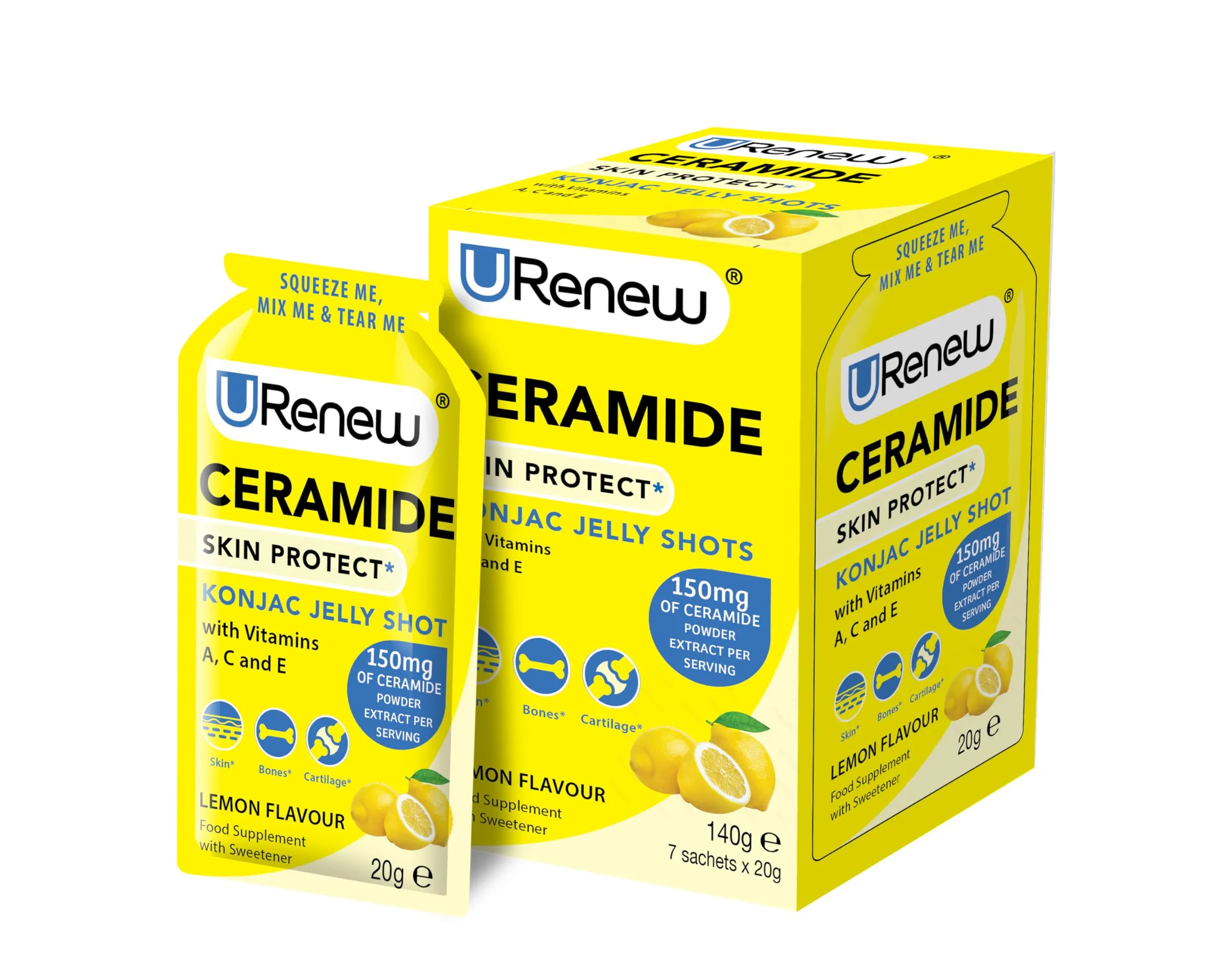
Her current post is director of innovation and product technology at Urenew Beauty UK, a London brand that trades as URenew. Her society profile names the company behind it as Muscle Doc Ltd, which Companies House records as incorporated in December 2019 with a registered office in the City of London. The brand describes itself as “Designed in London. Created for women everywhere.” Its website currently sells three collagen hydrogel masks, for face, eyes and neck. On Amazon it sells lemon-flavoured konjac jelly sachets, each containing 150mg of a ceramide extract from rice bran with vitamins A, C and E, labelled as a food supplement made in the United Kingdom. The company does not publish revenue or headcount. It is a small business, and her public reputation has been built largely outside it.
Urenew’s sachets put her inside one of the fastest-growing corners of beauty. A 2026 report from in-cosmetics, citing the research firm Mordor Intelligence, put the global market for nutricosmetics, supplements sold for skin, hair and nails, at about US$9.4 billion, with a forecast of US$14.4 billion by 2030. In March, NutraIngredients interviewed Pramanik on the science behind the category. She was careful about mechanism. Collagen peptides, she said, are broken down when swallowed and may act as signals to the cells that maintain the skin, rather than being rebuilt into it: “A helpful way to think about this is not as replacing bricks in a wall, but as prompting the maintenance crew to do their job more efficiently.”
She was more careful still about proof. “Hydration can be measured using corneometry,” she said. “Elasticity can be assessed by observing how skin returns to shape after deformation. Barrier function can be estimated through TEWL”, the rate of water loss through the skin. The category, she argued, is “moving away from broad promises of ‘beauty in a bottle’ toward more specific, biologically framed benefits such as hydration support, barrier resilience, or microbiome balance.”
A simple way to see it is this: topical skincare adjusts what the skin is exposed to, while nutricosmetics influence what the skin is built from and how it responds.
Readers should know what the article also made plain: her employer sells an oral ceramide product, and ceramides were among the ingredients she discussed. That does not make the science wrong. It is the kind of context she asks other people to supply.
Career timeline
- Early career
Biotechnology engineering degree (gold medal)
first roles in India, according to her profiles (employers not published)
- 2018
Executive certificate, MIT Sloan School of Management
- Before 2025
Product-development roles in the Los Angeles area and in London (employers and dates not published)
- Oct 2024
Launches the YouTube channel INCI with Rinki
- Sep 2025
Director of innovation and product technology, Urenew Beauty UK
records a live episode at the Cosmetics Compliance Summit, London
- Nov 2025
First bylined article for Cosmetics Business
- Apr 2026
in-cosmetics Global, Paris: awards judge, brand ambassador and panellist
- Sep 2026
Begins the “Bench to bottle” column series
- Nov 2026
Speaks on scientific storytelling at SCS Formulate, Coventry
Chapter three: A Channel Called INCI
The channel began on 4 October 2024. By 12 November 2026 it had 80 videos, 12,700 subscribers and about 190,000 views: modest figures by the standards of beauty influencers, and considerable ones for a channel whose recurring subject is ingredient nomenclature. Its description sets out the purpose in the first person: “As a cosmetic scientist, my mission is to simplify complex cosmetic chemistry, promote ingredient transparency, and inspire innovation in the beauty industry.” It also carries a disclaimer that the channel is not affiliated with or endorsed by the Personal Care Products Council, the American association that publishes the INCI names.
The early episodes were explainers of single ingredients: collagen, kojic acid, ectoin. Then they widened towards the business behind the jar. Episode 20, in March 2025, set out the six labelling requirements of UK cosmetics law for small brands and founders: the Responsible Person, the legally accountable party for every cosmetic on the British market; the Product Information File; notification to the Office for Product Safety and Standards; and the duty to report serious undesirable effects. Its description opened with a line that could stand for the whole channel: “Is your cosmetic product truly compliant, or are you just hoping no one checks?”
Episode 22 brought in Dan Williams, chief executive of the British private-label manufacturer Orean, under the title “Who Really Makes Your Products?” The episode covered who owns a formula a brand has paid a manufacturer to develop, how minimum order quantities shape price, and what “turnkey” means. Episode 24, on exosomes, posted in April 2025, has been watched nearly 9,000 times, the most of the episodes we checked. It appeared a year before she stood in the aisles in Paris counting exosome launches.
By 2026 the channel had become a small media operation. There are interviews from the in-cosmetics floor; a Lab Series in which she formulates an emulsion on camera; reviews of products from CeraVe and Maybelline; and Beyond the Boardroom, a run of conversations with founders and scientists. The October episode, with Smitha Rao, a cosmetic scientist who founded the brand Parëva Beauty, was billed as a discussion of “the realities of being a woman in science”. In September 2025 she recorded an episode live on stage at the Cosmetics Compliance Summit in London. In December she was the guest, rather than the host, on Provitalks, the podcast of the Spanish ingredient maker Provital, for a 70-minute conversation on formulating for the British market.
The writing followed. Since November 2025 she has written for Cosmetics Business on chicory root, on the longevity research behind what is called cryptic transcription, and now in “Bench to bottle”. Her January piece on cryptic transcription carried a line that reads like a statement of method: “As a cosmetic scientist and storyteller, I often say: ageing is not just something we see, it is something our cells say. And now, science is learning how to listen.” The society made her a council member. in-cosmetics made her an official ambassador for its 2026 Paris show and put her on its judging panel.
The arrangement has a tension in it that the channel’s audience is entitled to think about. Much of what she explains comes from the companies that make the ingredients, because that is where new chemistry is first disclosed. Her trade-show videos feature named suppliers’ actives; her lab series builds a formula around two of them. A 2025 article she wrote for the ingredient marketplace Covalo set out two suppliers’ longevity actives with the suppliers’ own results, including the claim that “AI analysis found users looked up to 6 years younger in 28 days”, without the reservations she would apply to PDRN a year later. The video descriptions we read carry no paid-partnership labels. A post of hers on LinkedIn says that one recent Instagram series is not a paid partnership, which suggests she has thought about the question. The public record does not show which of the rest, if any, involve payment, samples or affiliate fees. She also runs an Amazon storefront.
None of this is unusual in trade media, and none of it suggests that anything she has said is untrue. It does mean that a science communicator who works inside the industry needs the same disclosure she asks of ingredients. Read in order, her writing suggests someone tightening her own standard. The 2025 Covalo article celebrates; the 2026 columns ask whether the molecule in the bottle is the molecule in the research.
Chapter four: Two Clocks
There is a British reason why ingredient literacy has become a professional skill. When the United Kingdom left the European Union, it kept the EU Cosmetics Regulation as its own law, frozen as it stood on 1 January 2021. Amendments made in Brussels no longer apply in Britain automatically. Each has to be assessed and legislated again in London, or not at all.
In 2026 that produced two calendars for the same chemistry. The European Commission adopted a regulation in January banning a new batch of substances classified as carcinogenic, mutagenic or toxic to reproduction, applicable from 1 May 2026. Britain followed with its own instrument, which bans most of the same substances from 15 August 2026, bans the UV filter 4-methylbenzylidene camphor from 15 July, and sets sell-through dates running into February 2027, according to a briefing by the law firm Mishcon de Reya. The UK also lowered the level at which products containing formaldehyde-releasing preservatives must carry a warning, from 0.05 per cent to 0.001 per cent. Northern Ireland, meanwhile, continues to follow the EU rules. A developer in London working on a product for both markets is working to two rulebooks that mostly agree, on dates that do not.
The trade figures show why that matters. The British cosmetics market was worth €14.7 billion in 2025 at retail prices, second in Europe after Germany, according to Cosmetics Europe. Britain imports more cosmetics than it exports: the trade body CTPA puts the 2025 deficit at more than £1.6 billion, notes that the value of imports has risen 61 per cent since 2021, and says 65 per cent of them come from the EU. A growing share of what British shoppers put on their skin is made under a rulebook other than their own.
The shoppers, for their part, are anxious and not well informed. In YouGov’s poll of 1,007 adults on 31 March, 61 per cent said they were concerned about the safety of ingredients in products including cosmetics. Thirty-two per cent had switched to products they perceived as more “natural” or “clean”, a marketing word with no INCI name. Yet only 29 per cent said they checked ingredients often or always. In the Skin Rocks survey, 85 per cent of women said skincare was packed with jargon the average person struggles to follow, and 86 per cent did not know what niacinamide is mainly used for. Those numbers come from a brand that sells simplicity and should be read with that in mind. They still describe a market in which the information on the pack is complete and of little use to most of the people reading it.
On 11 November Pramanik took that problem to the Society of Cosmetic Scientists’ Formulate show at the Coventry Building Society Arena, in a talk titled “From Molecule to Meaning: The Art of Scientific Storytelling”. The programme’s description of the session puts the argument in two sentences: “Ingredient transparency should not mean handing consumers more data. It should mean giving them better context.” It also offers a diagnosis of the industry she has worked in for 16 years: “Maybe science just needs a bigger microphone.”
The questions for her next chapter are concrete. Can someone whose channel is built on supplier relationships be the independent check her columns aim to be, and will she publish how those relationships work? Will the standard of “Bench to bottle”, the same four letters, different molecules, be applied as visibly to the claims of the small company that employs her? And can the industry’s own scientists close a gap that its marketing departments opened, when the regulators on either side of the Channel can no longer agree on a date?
The back of a URenew ceramide box, as listed on Amazon, begins: Purified Water, Fructose Syrup, Ceramide Rice Bran Extract. Because the product is a food supplement, those names follow food law, not the cosmetic INCI system. The list is accurate and complete. What it means, and what it can prove, is the part Rinki Pramanik has made her work.